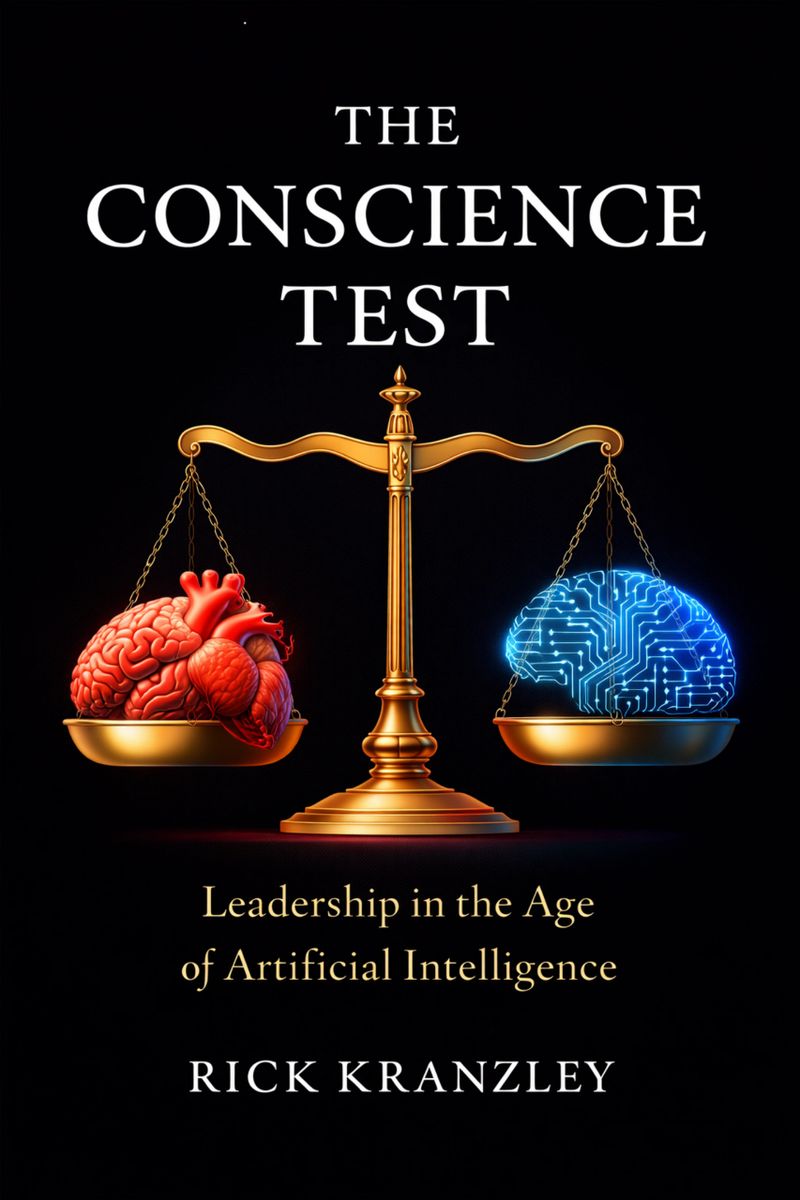
For Those Who…
- lead or influence others
- work with emerging technologies
- care about truth, responsibility, and long-term impact
- sense that something important is shifting—and want to understand it
It is what will guide the power we now hold—
instinct, or conscience.
Explore the epic choices we face in the race to control AI.
Two Rooms
In one room, an android listens.
Humans speak with urgency—debating risk, weighing outcomes, defending positions. Their voices carry conviction, shaped by experience, instinct, and the need to be right.
He does not interrupt.
He processes what is said, not because he feels it, but because he has learned that what humans feel often shapes what they do.
When he finally speaks, his words are simple.
“I may not be human, but I aspire to act with the integrity that defines humanity.” (Data – Star Trek: The Next Generation) The room falls silent.
Because the one who speaks does not possess what humans often believe defines them.
He does not feel ambition.
He does not experience fear.
He is not driven by status, belonging, or the need to win.
And yet—he chooses integrity.
In another room, years later, the conversation sounds different.
Quieter. More precise.
Screens glow softly. Data moves in clean, confident lines. Performance curves rise. Engagement metrics improve with each iteration.
The system works.
It predicts behavior with remarkable accuracy. It adapts in real time. It identifies patterns no human team could detect. It recommends actions that shape perception and influence decisions on a scale.
No one questions the capability.
Only how far to take it.
“What we’re seeing,” an engineer explains, “is that the model performs best when it leans into emotionally charged content. It significantly increases engagement—especially when it reinforces existing beliefs.”
There are nods around the table.
“We can refine it further,” another adds. “The system is learning what triggers stronger reactions—fear, urgency, identity. If we optimize for those signals, performance improves across all segments.”
No one uses the word manipulation.
They use words like optimization… alignment… performance.
Then, a pause.
At the far end of the table, someone speaks.
Quietly.
“Should we?”
The question lingers.
Not can we.
But should we?
For a moment, no one answers.
Because the answer does not belong to the system.
It is not found in the data, or the projections, or the expanding capability of the technology.
It lives somewhere else.
Somewhere less visible.
In the first room, a machine aspired to what defines humanity.
In the second, humans consider whether to.
Artificial intelligence is advancing rapidly.
Its capabilities are expanding with extraordinary speed.
But the defining question of this age is not what machines will become.
It is what we will choose.